Interpretation of the Thirty-Third Rule of Love
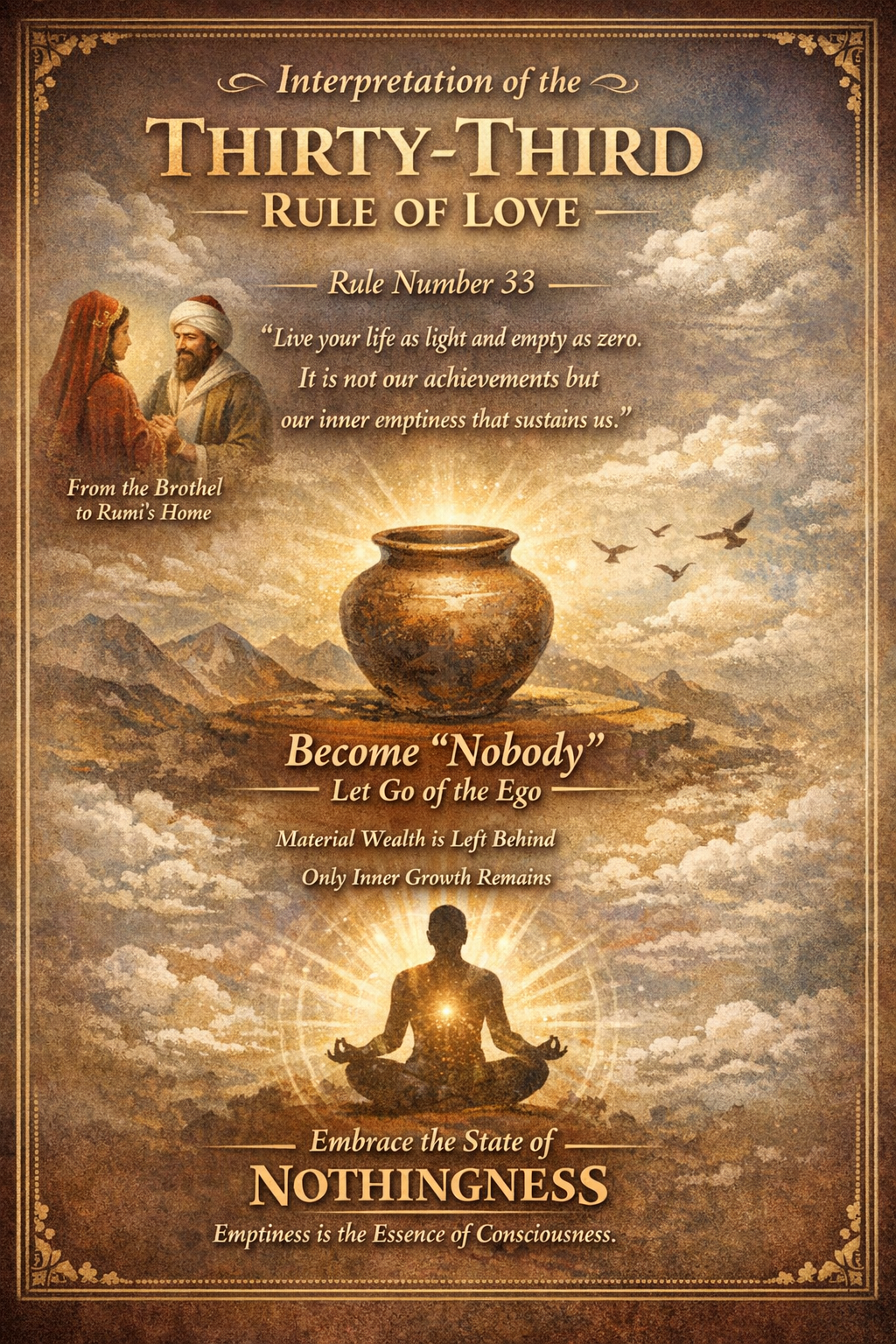
Rule Number 33 — While everyone in this world strives to get somewhere and become someone, only to leave it all behind after death, you aim for the supreme stage of nothingness. Live this life as light and empty as the number zero. We are no different from a pot. It is not the decorations outside but the emptiness inside that holds us straight. Just like that, it is not what we aspire to achieve but the consciousness of nothingness that keeps us going.
Context - This rule appears when Desert Rose leaves the brothel and arrives at Rumi’s home. There, she meets Shams, who introduces her to this teaching as a step toward a deeper and more meaningful life.
Interpretation within the Story - In the story, Desert Rose has lived a worldly life, largely against her will. Though she always felt drawn to spirituality, circumstances pushed her into a life she did not choose. Now, with the courage to leave the brothel and the guidance of Shams, this rule reminds us that it is never too late to turn toward the divine. It shows that true life begins the moment we start moving inward.
Deeper Interpretation Beyond the Story - This rule highlights the emptiness of a purely materialistic life and the importance of beginning a spiritual journey. Through Desert Rose, Shams speaks to all of us. While most people strive to become “somebody,” the spiritual path is about becoming “nobody.” At the time of death, all material achievements are left behind, and only our inner growth remains.
Shams speaks of reaching a state of nothingness, which points to the dissolution of the ego. For the human mind, becoming “nobody” can feel frightening, yet this is exactly what the spiritual path requires.
Material and spiritual lives move in opposite directions, and so do their principles. Material success is measured by what we accumulate externally, while spiritual success is measured by what we are able to release internally.
Shams encourages us to become inwardly empty so that existence can work through us as an instrument. Osho says that just as a cup is useful because of the space it holds, we become useful to the divine only when we empty ourselves of ego.
The essence of this rule is to turn inward, transcend the ego, and arrive at a state of nothingness. This inner emptiness is not a void to fear—it is the very essence of consciousness. It is not just something we attain; it is what we truly are.
Gratitude!!!!


Leave a Reply