
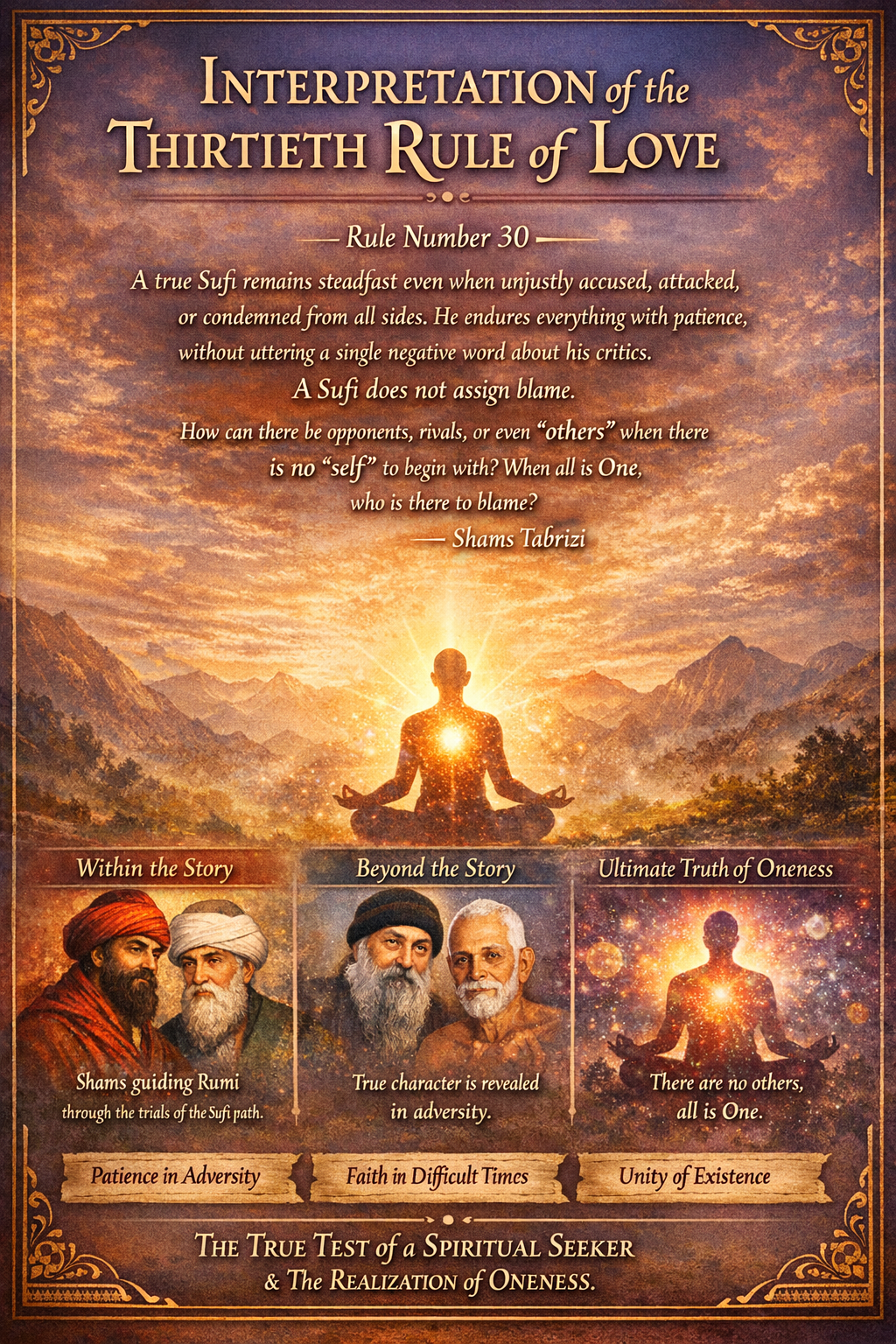
Interpretation of the Thirtieth Rule of Love
Rule Number 30 — The true Sufi is such that even when he is unjustly accused, attacked and condemned from all sides, he patiently endures, uttering not a single bad word about any of his critics. A Sufi never apportions blame. How can there be opponents or rivals or even “others” when there is no “self” in the first place? How can there be anyone to blame when there is only One?
— Shams Tabrizi, to Self
Context - This rule arises when Shams reflects upon the accusations and criticism that both he and Rumi had to face from society due to their deep bond. In that moment, Shams recognizes that they are undergoing a testing phase of the Sufi path, something every true seeker must inevitably pass through.
Interpretation within the Story - Shams had spent most of his life as a Sufi, so such criticism did not disturb him. In fact, he was accustomed to facing negativity from the ordinary world.
However, his concern was for Rumi. Rumi had always been admired and respected as a scholar, receiving praise from all directions. When those same people suddenly turned against him, it became a profound test of his patience and inner strength, especially since he was still new to the Sufi path.
This is where the rule fits perfectly, showing how a true Sufi responds even in the face of adversity.
Deeper Interpretation Beyond the Story - Osho says that one’s true character is revealed in times of adversity. It is easy to speak of peace and non-violence in comfortable settings, but the real test comes when one is challenged. True non-violence is proven only when one has the power to harm, yet chooses restraint.
Similarly, in spiritual life, the real test of faith arises when circumstances go against our desires. It is easy to worship when everything is going well, but true faith is to remain trusting even during difficult times, knowing that something meaningful will emerge from them.
A genuinely spiritual person does not react, even when wrongly accused. Instead, he sees such situations as tests of patience and accepts them as part of the divine will.
During such moments, he turns inward, working on his own awareness rather than wasting energy defending himself. He understands that reacting or justifying himself may only create further conflict. Therefore, he strives to reach a state of inner indifference and balance.
At a deeper level, this rule points to an even higher truth. A true Sufi recognizes the unity of existence. When all is an organic whole, who is there to project the blame and who is there to receive the blame?
The idea of “others” arises only when there is a sense of separation within us. When this separation dissolves, the concept of “others” disappears as well.
This is the truth repeatedly emphasized by Ramana Maharshi, who taught that “there are no others.”
For the ordinary mind, this level of understanding can be difficult to grasp. The perception of “others” begins only when we experience ourselves as separate from existence. Once that separation dissolves, the division between self and others also vanishes.
For one who realizes that existence is a single, unified whole, there is no question of treating anyone as separate.
This rule reveals both the true test of a spiritual seeker and the ultimate truth of oneness.
Gratitude!!!


Leave a Reply