
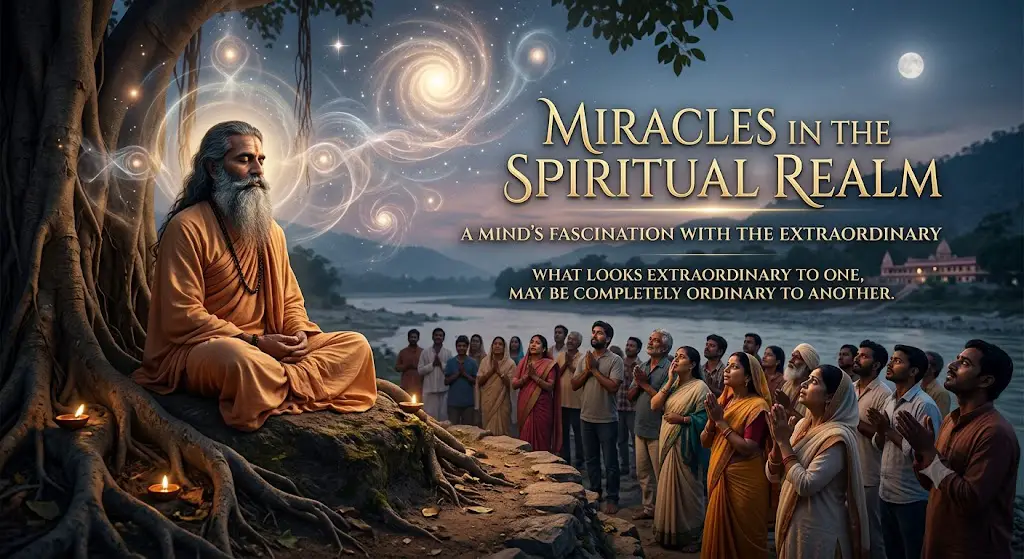
Importance of Miracles in the Spiritual Realm
What is a miracle?
A miracle can simply be understood as something beyond the comprehension of the mind. When something happens and our mind cannot find a logical explanation for it, we call it a miracle.
In that sense, the word "miracle" is relative to the level of our understanding. Something that looks miraculous to one person may be completely ordinary to another person who understands how it happens.
For example, if someone who has never seen a magician perform a particular trick sees it for the first time, they may consider it a miracle. But for the magician, there is nothing miraculous about it—they know the mechanism behind the act.
So, an important question arises: Is something really a miracle, or does it only appear miraculous because we don't understand it?
This distinction becomes particularly important when we enter the spiritual realm.
Chamatkar Ko Namaskar
There is a very common tendency among human beings summarized by the phrase: "Chamatkar ko Namaskar"—we tend to bow down before a miracle.
A person may not be interested in a Guru's teachings, wisdom, awareness, or way of life. But if someone tells them that the Guru performed a miracle, their interest is suddenly awakened:
a. "What miracle does he perform?"
b. "Can he materialize something?"
c. "Can he predict the future?"
d. "Can he heal someone?"
e. "Can he know what is happening somewhere else?"
These questions often take priority over the actual spiritual teachings of the Guru. This is where the problem begins. Approaching spirituality primarily to witness a miracle means approaching it through the mind's fascination with the extraordinary.
Should Miracles Have Any Place in Spirituality?
Ideally, miracles should not be the criterion for following a Guru. In fact, they should have very little or no place in spirituality.
A miracle, by itself, does not reveal the consciousness of the person performing it. A magician can also perform actions that appear impossible to an ordinary person; the difference is that the magician knows the underlying mechanism while the audience does not. Therefore, when someone performs an extraordinary act, our default response should not be to assume they are spiritually evolved.
What matters far more are deeper questions:
a. What is this person's presence doing to my consciousness?
b. Are they helping me become more aware?
c. Are they helping me see my unconscious patterns?
d. Are they helping me become less egoistic?
e. Are they helping me understand myself and move from unconsciousness toward awareness?
Osho's Perspective on Miracles
Osho often pointed out that the attraction toward miracles reflects a certain level of immaturity in human consciousness. When people lack sufficient education, awareness, or intelligence to understand something, they easily become fascinated by extraordinary phenomena.
Consider the contrast between Jesus and Buddha:
i. Jesus performed many miracles according to scriptural stories. The society surrounding Jesus was largely uneducated, making miracles a language through which people could be drawn to his presence.
ii. Buddha, on the other hand, did not depend on miracles. The people around Buddha included educated and intellectually developed individuals who were attracted by his wisdom, understanding, and vision of existence.
To put it simply: an uneducated mind may be attracted by a miracle, whereas an educated mind is attracted by wisdom. (This is a general principle rather than a literal rule for every single follower. There can always be exceptional cases.)
If an attraction is based solely on something appearing impossible, it remains rooted in the mind's fascination with the extraordinary. If it is based on a Guru's words transforming how one sees life, something much deeper is occurring.
Why Do Miracle Performers Attract Large Crowds?
Whenever someone becomes famous for performing miracles, large crowds gather. People want to see something extraordinary that their logical mind cannot explain.
However, once the mind encounters something it cannot explain, it often jumps to a conclusion: "This person must have supernatural powers."
There is a significant gap between two distinct statements:
i. "I don't understand what happened." (An observation)
ii. "This person is spiritually enlightened." (A conclusion)
The conclusion may or may not be correct, which is why conscious awareness is required.
What About Gurus Who Actually Perform Miracles?
If miracles should not be central to spirituality, how do we interpret spiritual Masters known for extraordinary events around them, such as Neem Karoli Baba and others?
We do not necessarily need to dismiss these experiences. Real Gurus do not intentionally perform miracles to impress people as without ego, there is no need to prove anything, show off, or build an audience through extraordinary performances.
Yet, extraordinary phenomena may naturally occur around such individuals.
When the Ordinary Looks Miraculous
This reveals a deeper meaning of miracles in spirituality: a Guru operates from a dimension of consciousness beyond the comprehension of the ordinary mind. Something completely ordinary to the Guru may appear miraculous to an observer.
The Guru may not consider themselves to be performing a miracle at all; for them, it may be as natural as breathing. The "miracle" lies in the gap between the consciousness of the Guru and the comprehension of the observer.
The Problem With Following Miracles
If you are looking for a Guru, miracles should not be your primary criterion. Witnessing something extraordinary still leaves the most critical question unanswered: Is this person helping me evolve?
a. Amazement is not awareness.
b. Faith based on wonders is not understanding.
c. Surrender without awareness can become another form of unconsciousness.
d. Instead of asking, "What miracle can this Guru perform?" ask: What happens to me when I am around this Guru? Do I become more aware and truthful with myself? Do I see my unconscious conditioning more clearly? Do I become less dependent on external validation? Do I become more silent, compassionate, and present? Am I learning to witness my own mind and take responsibility for my evolution?
Don't Look for the Extraordinary
People often seek a Guru expecting something extraordinary, yet the true work of a Guru is to return us to the most ordinary reality: ourselves.
The mind continually searches for the special, the supernatural, and the extraordinary to create stories. But true awareness is simple and ordinary:
a. Watching your thoughts and reactions.
b. Seeing your desires and understanding your fears.
c. Observing your ego and remaining present.
d. Seeing reality without drawing unnecessary conclusions.
These practices do not look like miracles, yet they represent a far greater transformation than any external event.
What Should We Look for in a Guru?
Focus less on what a Guru can do and more on what the Guru is:
i. Observe their awareness, presence, and freedom from ego.
ii. Notice whether their teachings foster dependence or inner freedom.
iii. Check if they help you become more conscious or simply offer another belief system.
iv. The purpose of spirituality is not to find someone who performs extraordinary acts, but to discover the extraordinary within ordinary existence itself.
Key Takeaways
a. Miracles are relative: An event appears miraculous primarily when the mind lacks the framework to understand it.
b. Presence over phenomena: A teacher's value lies in how their presence transforms your consciousness, not in extraordinary feats.
c. Acknowledge without blind faith: If an unexplained event occurs, acknowledge your lack of understanding without converting it into immediate belief or assuming spiritual enlightenment.
d. The real miracle is internal: The greatest transformation is not an external wonder, but the unfolding of clarity, self-awareness, and presence within you.
Gratitude!!!


Leave a Reply