
Interpretation of the Thirty-Sixth Rule of Love
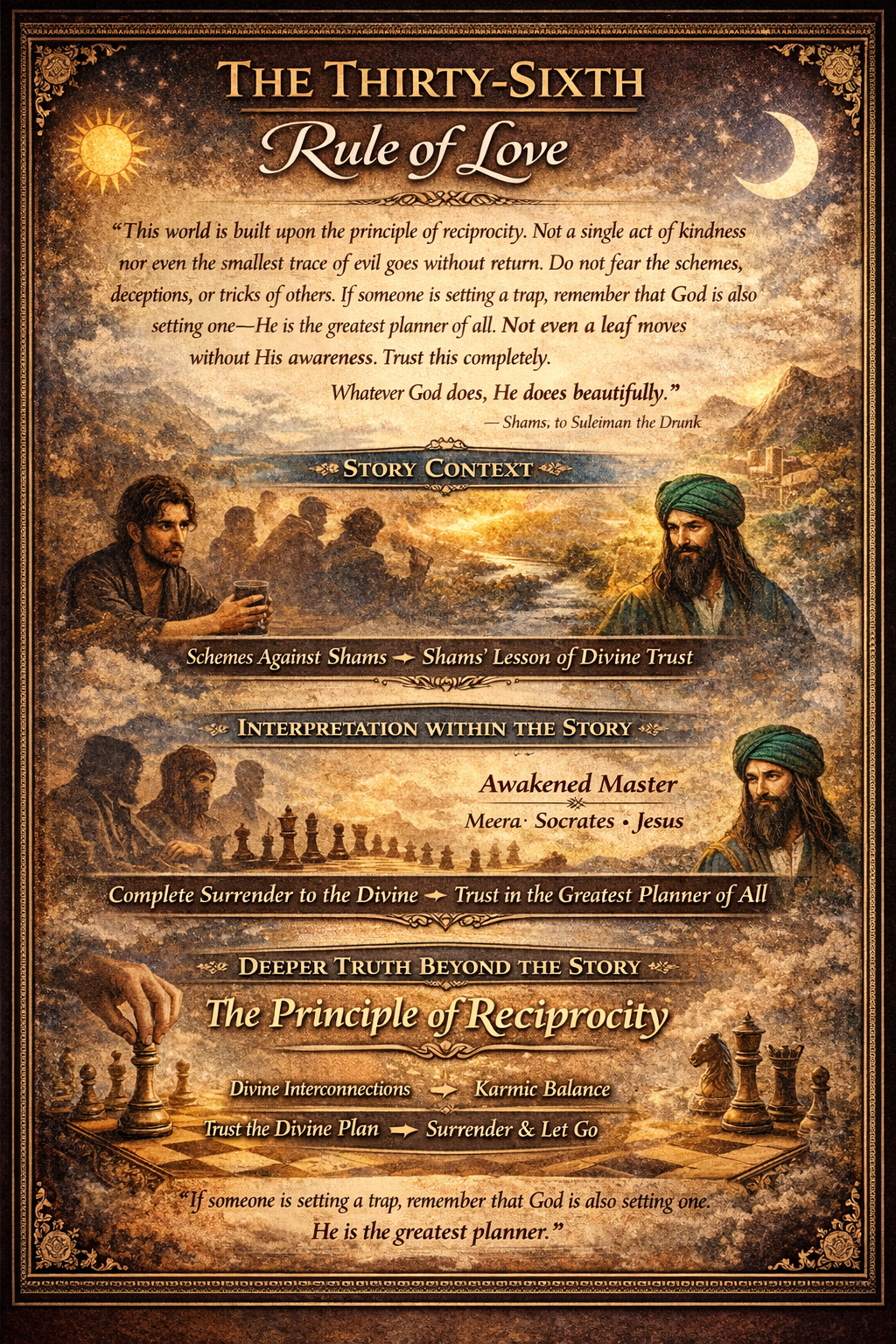
Rule Number 36 — This world is erected upon the principle of reciprocity. Neither a drop of kindness nor a speck of evil will remain unreciprocated. Fear not the plots, deceptions, or tricks of other people. If somebody is setting a trap, remember, so is God. He is the biggest plotter. Not even a leaf stirs outside God’s knowledge. Simply and fully believe in that. Whatever God does, He does it beautifully.
– Shams, to Suleiman the Drunk
Context - This rule appears when Suleiman discovers that a few people are plotting to kill Shams and attempts to warn him. Being completely surrendered to the Divine, Shams responds with this rule, reaffirming his absolute trust and surrender.
Interpretation within the Story - As an awakened master, Shams embodies total surrender to the Divine Will. For such a being, everything that happens in the world unfolds only because it is allowed by the Divine. Even the possibility of death is not resisted, as it too would occur only with divine permission.
The spiritual world is filled with similar examples where awakened beings accepted even their deaths with grace, such as Meera, Jesus, and Socrates.
This rule highlights and reinforces that deep state of surrender found in enlightened beings.
Deeper Interpretation Beyond the Story - As discussed earlier in Rule 34, a person who is truly surrendered to the Divine remains in a state of inner peace and tranquility. Such a person trusts that nothing can truly go wrong when everything unfolds through divine will. Even in extreme situations, they remain inwardly detached and unaffected. Their inner stillness is untouched by external chaos. This represents the highest form of surrender, which naturally brings the highest level of peace.
A truly surrendered individual understands that nothing can happen in existence without divine permission. If something occurs, it is because it is allowed at a deeper level. This is why figures like Meera, Socrates, and Jesus could even accept death with openness and grace.
This rule further expands on that idea by introducing the principle of reciprocity, often understood as karma. Since all of existence is interconnected, every action creates a response. Think of existence as a tightly woven web—if one part is disturbed, the effect travels throughout the entire structure.
In the same way, every action is reciprocated. Acts of kindness return in some form, from somewhere or someone. Similarly, acts of harm also return, though not necessarily from the same source. The sense of separation exists only in the mind, not in reality.
Shams also expresses a profound mystical insight: “If someone is setting a plot, remember so is God. He is the greatest planner.”
This points to a deeper truth. From our limited perspective, we believe we are the doers, making plans and executing actions. However, even the impulse to plan arises from the Divine. What we perceive as our own strategy is, in reality, part of a much larger divine design.
Thus, while we may think we are setting traps or making plans, we are simultaneously participating in a greater plan that is beyond our understanding.
In essence, this rule teaches complete trust, surrender, and faith in the divine order—reminding us that nothing happens outside its wisdom.
Gratitude!!!


Leave a Reply