The Future of Human Work: From Mind to Heart
The
Growing Impact of Artificial Intelligence
We are entering a phase of human history where Artificial Intelligence is going to transform our lives in ways that we may not yet fully comprehend. AI is no longer limited to simple calculations or repetitive tasks. It can write, analyse, translate, design, code, research, communicate and perform many intellectual functions that were previously considered uniquely human. And this is only the beginning. The future is going to see increasing use of AI, Robots and other forms of automation in almost every area of human life. Because of this, I feel that we need to reconsider one of our deepest assumptions about life:
What should a human being prepare himself or herself for as a career?
For generations, the answer was relatively simple. Study well. Get a good degree. Find a secure job. Work for a good company. Retire safely. But this model may not remain relevant in the same way in the coming decades.
The End of the Traditional Job Setup
For a long time, education has primarily been designed to prepare human beings for employment. A child studies so that he can eventually get a job. Parents often ask: "What career will give my child a secure future?" The obsession with a "secure job" has become so deeply embedded in our minds that we rarely question it. But what happens when the very nature of employment starts changing? If a machine can perform a particular task faster, cheaper and more accurately than a human being, why would a business continue to employ thousands of people to perform that task? This is not necessarily a question of whether AI is good or bad. It is simply a question of efficiency.
And therefore, I believe that the traditional job-oriented career structure is going to undergo a massive transformation. Many jobs that currently require human beings may eventually be performed by AI, Robots or a combination of both. The exact percentage is impossible to predict, but it would not be surprising if a very large portion of today's routine and intellectually repetitive work becomes automated. Therefore, the next generation needs to prepare for a completely different professional environment.
The Future May Belong to Entrepreneurship
If traditional employment becomes increasingly automated, one possible direction for the future is entrepreneurship. Instead of preparing every child primarily to become an employee, perhaps education and parenting need to encourage children to become creators, innovators and entrepreneurs. This does not mean that everybody has to start a huge company. Entrepreneurship can simply mean creating something of your own. It can mean identifying a problem, understanding people's needs and creating a service or product that genuinely helps them. It can be a small business. It can be a consulting practice. It can be an artistic or creative profession. It can be healing work. It can be teaching. It can be a technology-based enterprise.
The important thing is that the person is not merely preparing himself to become a replaceable unit in somebody else's system. He is creating value himself. This is where parents may also need to change their approach. Instead of asking only, "Which profession will give my child a secure job?" perhaps we should also ask, "What can my child create?" "What problem can my child solve?" "What unique human quality can my child bring into the world?" These questions may become far more important in the future.
But Even Entrepreneurship Will Change
However, there is another important point here. Simply becoming an entrepreneur will not automatically make a person future-proof. Why? Because AI will increasingly enter the world of business as well. Suppose your business primarily involves intellectual processing, information analysis, calculations, documentation, coding, writing, designing or other activities that can be performed through algorithms. AI will eventually become extremely powerful in these areas. In fact, it may become much better than an average human being.
This brings us back to what Osho says in his Geeta Darshan. Osho points towards a future where the human being who has reduced himself only to intellect becomes increasingly replaceable by the computer. The computer can calculate. The computer can analyse. The computer can process information. The computer can perform enormous numbers of operations in a fraction of the time required by human beings. But there is something it cannot do. It cannot feel.
The Difference Between the Brain and the Heart
According to Osho, when a person begins to live only through intellect, the centre of feeling gradually falls asleep. Such a person may continue functioning perfectly. He may become an engineer. He may become a doctor. He may become a lawyer. He may run a business. He may perform his professional responsibilities extremely efficiently. But something essential has disappeared. He has become almost like a computer. And this is perhaps one of the most important messages for humanity in the age of AI.
If we compete with machines on their own ground, we are going to lose. A machine can calculate better. A machine can remember more. A machine can process information faster. A machine can work continuously. A machine does not need sleep, holidays or motivation. Therefore, trying to defeat AI by becoming an even better intellectual machine may not be the answer. Perhaps the answer is to become more human.
The Heart That Machines Cannot Have
When we talk about the heart, we usually think about the physical organ that pumps blood throughout the body. But Osho points towards another heart. There is a physical heartbeat which can be measured. And there is another heartbeat which belongs to the world of feeling.
Love. Compassion.
Sensitivity. Intimacy. Empathy. Presence. Understanding. Connection.
These cannot simply be reduced to intellectual calculations. And this may become the greatest strength of humanity in the age of AI. A machine may be able to give you information. But information is not necessarily wisdom. A machine may be able to simulate empathy. But simulation of empathy and actually experiencing feeling are not necessarily the same thing. A machine may be able to communicate with you. But human connection involves something beyond communication. It involves presence.
The Rise of Heart-Based Businesses
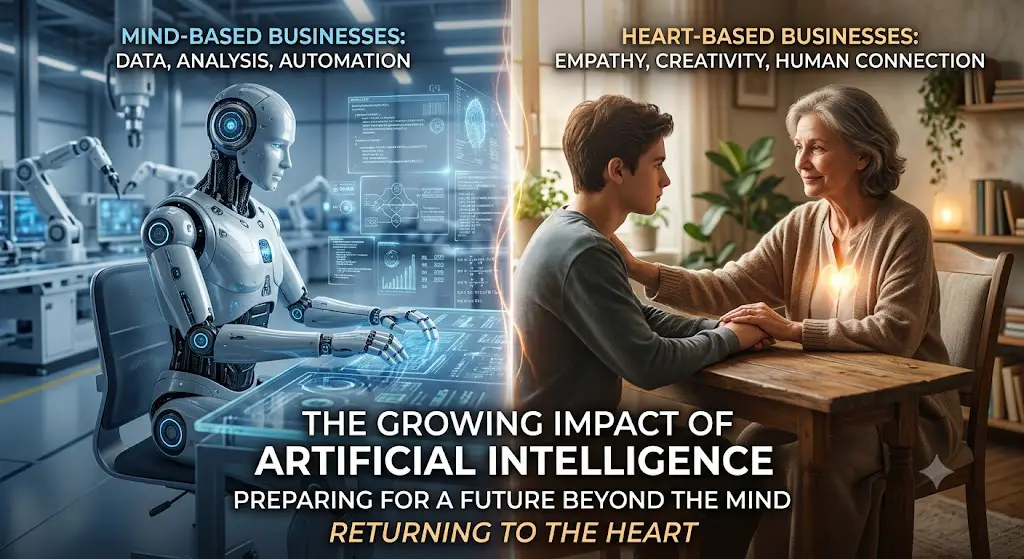
Therefore, I feel that the businesses of the future may increasingly divide into two broad categories.
One will be mind-based businesses. These will involve information processing, calculations, repetitive intellectual tasks, standardized services and activities that can increasingly be automated.
The other will be heart-based businesses. These will involve human connection, sensitivity, emotional understanding, healing, care, teaching, counseling, mentoring, creativity, companionship, and one-to-one interaction.
The
second category may become increasingly valuable. Imagine two people going
through emotional difficulties. One receives an automated response generated by
AI. Another sits with a human being who listens deeply, understands the
silence, feels the pain and is simply present.
Both may provide information. But they are not providing the same experience. The difference is human presence. This is where human beings may have an extraordinary advantage.
Human Touch May Become More Valuable
Ironically,
the more technology enters our lives, the more valuable genuine human contact
may become. When everything around us becomes automated, artificial and
digital, something authentic may become precious.
A
handwritten letter may become more meaningful in a world of instant
AI-generated messages. A real conversation may become more valuable in a world
of chatbots. A genuine teacher may become more valuable in a world where
information is freely available. A human healer may become more valuable when
technology can diagnose but cannot truly share the human experience of
suffering. A counselor may become more valuable because people may not simply
need answers. They may need to be heard. A spiritual teacher may become more
valuable not because he possesses more information, but because his presence
can create something within the seeker.
This may be one of the great paradoxes of technological evolution. The more machines take over information, the more human beings may have to return to feeling.
From Mind to Heart
This is where Osho's teaching becomes extremely relevant. If humanity has spent centuries developing intellect, perhaps the next step is not to destroy intellect but to go beyond its monopoly. We need the intellect. Science needs intellect. Technology needs intellect. Business needs intellect. But intellect alone cannot make a complete human being.
There needs to be feeling too. And when feeling becomes awakened, it can become a great support for self-restraint, what Osho refers to as sanyam. This is also why spiritual growth cannot simply be another intellectual exercise. You can collect thousands of books about meditation and still remain untouched. You can know everything about love and still not love. You can know everything about compassion and still remain insensitive.
Knowledge belongs to the mind. Transformation involves something deeper.
Prepare for the Future
Therefore, I feel that parents and the younger generation need to start preparing for this change now. My advise would be to get-away from the idea of getting a secure job. A guidance should be given that their entire future doesn't depend on one degree, one examination, or one corporate position.
Inspire and prepare them to create, to take responsibility, to understand others, to communicate, to listen. Teach them creativity. Teach them entrepreneurship. Teach them sensitivity. And most importantly, teach them how to remain human. Because the future may not reward the person who knows the most information. AI will probably know much more. The future may reward the person who can bring something that information alone cannot provide. Presence. Feeling. Creativity. Connection. Human touch.
Get Over the Obsession With a Secure Job
Perhaps the biggest psychological change required is to let go of our obsession with the "secure job." There may never have been absolute security in a job. But now the meaning of security itself is changing. The real security may not come from having a permanent position in an organisation. It may come from developing qualities that remain valuable even when the surrounding system changes.
If AI
can take away your particular job, what remains with you?
If your value comes only from performing a particular intellectual task, you may become replaceable. But if your value comes from your ability to connect, create, understand, inspire, heal, teach, lead or bring something deeply human into another person's life, then your relevance may actually increase.
The Future Is Not About Humans Versus AI
I don't think the future needs to be seen as a war between human beings and AI. AI can take over many things. And perhaps it should. Why should human beings spend their lives doing repetitive tasks that machines can perform more efficiently? Perhaps technology is not necessarily coming to take humanity's purpose away. Perhaps it is coming to force humanity to discover a deeper purpose.
If
machines take over our calculations, perhaps we can return to creativity. If
machines take over information processing, perhaps we can return to wisdom. If
machines take over repetitive work, perhaps we can return to meaningful work. If
machines take over the mind-based tasks, perhaps human beings can rediscover
the heart.
And perhaps this is the opportunity hidden inside the coming technological revolution.
The
Real Question
So the question is not simply: "Will AI take our jobs?" The deeper question is: "What is there in a human being that AI cannot replace?"
Osho's answer would take us towards feeling. And perhaps that is where we should look too. The future may belong to technology. The future may belong to AI. The future may belong to Robots. The future may belong to entrepreneurship. But ultimately, the future of humanity may belong to those human beings who have not forgotten how to feel. Because if we become nothing more than sophisticated computers, then computers will naturally become better than us. But if we rediscover the heart, then perhaps technology will not make human beings obsolete. Perhaps technology will finally give human beings the opportunity to become more human.
Gratitude!!!


Leave a Reply