
Interpretation of the Twelfth Rule of Love
Rule Number 12 — The quest for love changes user. There is no seeker among those who search for love who has not matured on the way. The moment you start looking for love, you start to change within and without.
– Shams (to Self)
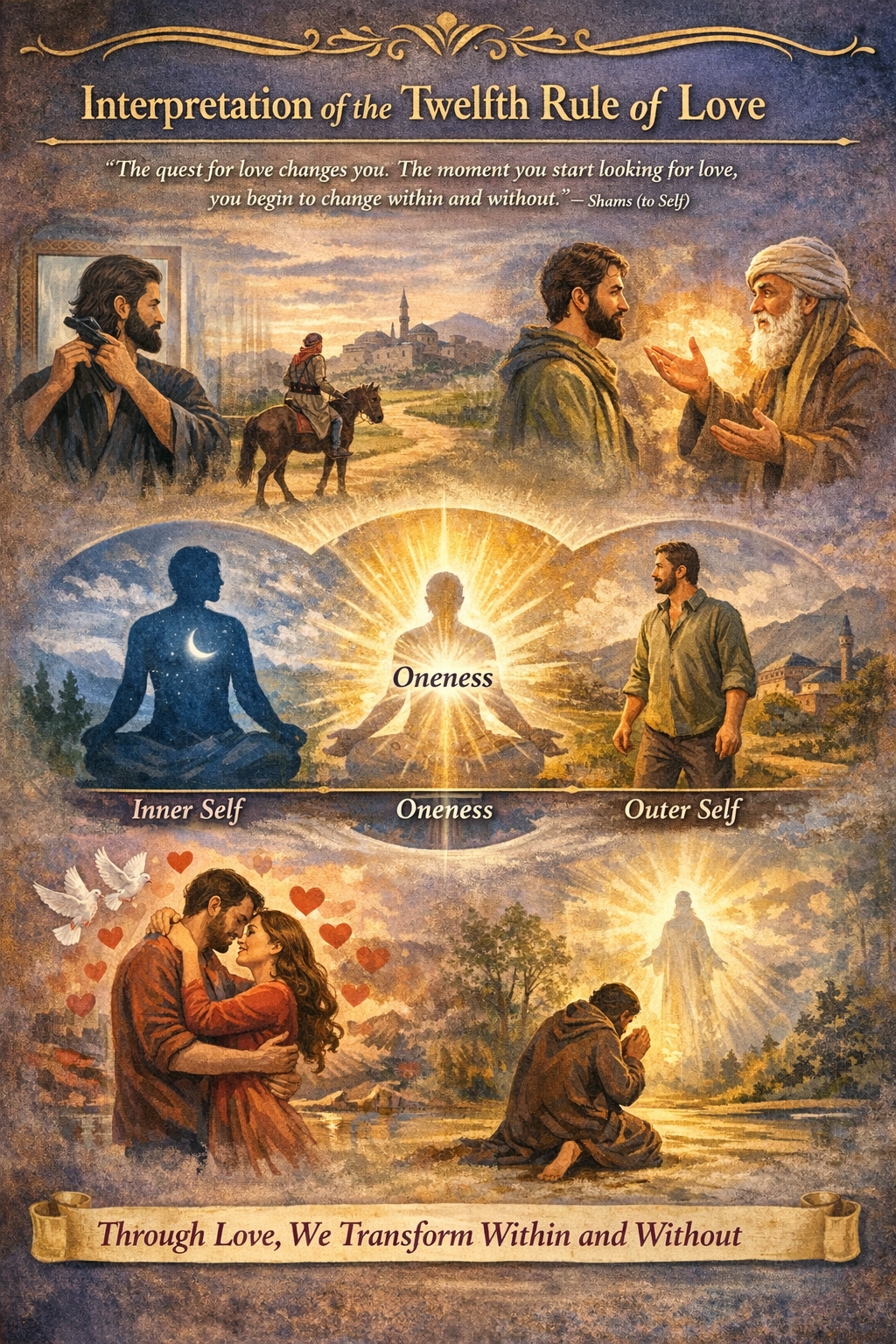
Context - This rule appears when Shams recalls how he prepared for his journey to Konya to meet Rumi. He remembers changing his appearance before setting out, and Baba Zaman remarks that this journey is already bringing changes in him.
It is at this point in the story that this rule emerges.
Interpretation within the Story - Within the story, the interpretation of this rule appears quite simple. As Shams was preparing for the journey, he changed his appearance. He cut his long hair, beard, and moustache. It is at this moment that Baba Zaman observes that the journey has already begun to transform him.
However, Baba Zaman is not referring only to the outward change in appearance. As a spiritual master, he is also pointing toward the inner transformation taking place. In reality, it is the changes within the inner self that eventually lead to changes in the outer self.
Thus, Baba Zaman and Shams are indicating that a spiritual journey brings transformation both within and without a person.
Deeper Interpretation Beyond the Story - If we look closely, the distinction between inner and outer is created by the human mind. The mind divides everything, and in doing so, it has divided the Self into two parts: the inner self and the outer self. In truth, such a division does not exist. If the temporary boundaries of the physical body were not present, what would be considered inner and what would be considered outer? Everything would simply be one.
This is why whatever we feel within ourselves eventually manifests in the outer world. A Guru on the path of Gyan Marg may say that awareness is the tool for transformation, but for a Sufi like Shams it is love that transforms. The Sufi path is similar to the Bhakti Marg in Vedic philosophy. Therefore, Shams emphasizes love as the true force of transformation.
Love may be directed toward spirituality or toward material pursuits, but in either case it has the power to transform a person. Even at the very personal level of romantic love, we can observe that when someone falls in love, they begin to display qualities such as selflessness, sharing, surrender, and devotion. This itself shows that love naturally brings transformation. That is why these rules repeatedly draw a parallel between love and the Divine.
One of the most important changes that love brings is the willingness to bow down one’s ego in order to sustain the relationship. This softening of the ego in human love becomes a preparation for eventually bowing the ego before the Divine.
Osho often narrated stories in which a Guru would say that he could help only those disciples who had loved someone at least once in their lives. In this sense, love becomes a prerequisite for the search for the Divine.
When you begin to look at life through the lens of love, your perspective toward life changes from within, and that inner shift inevitably brings changes in the outer world as well.
Gratitude!!!


Leave a Reply