
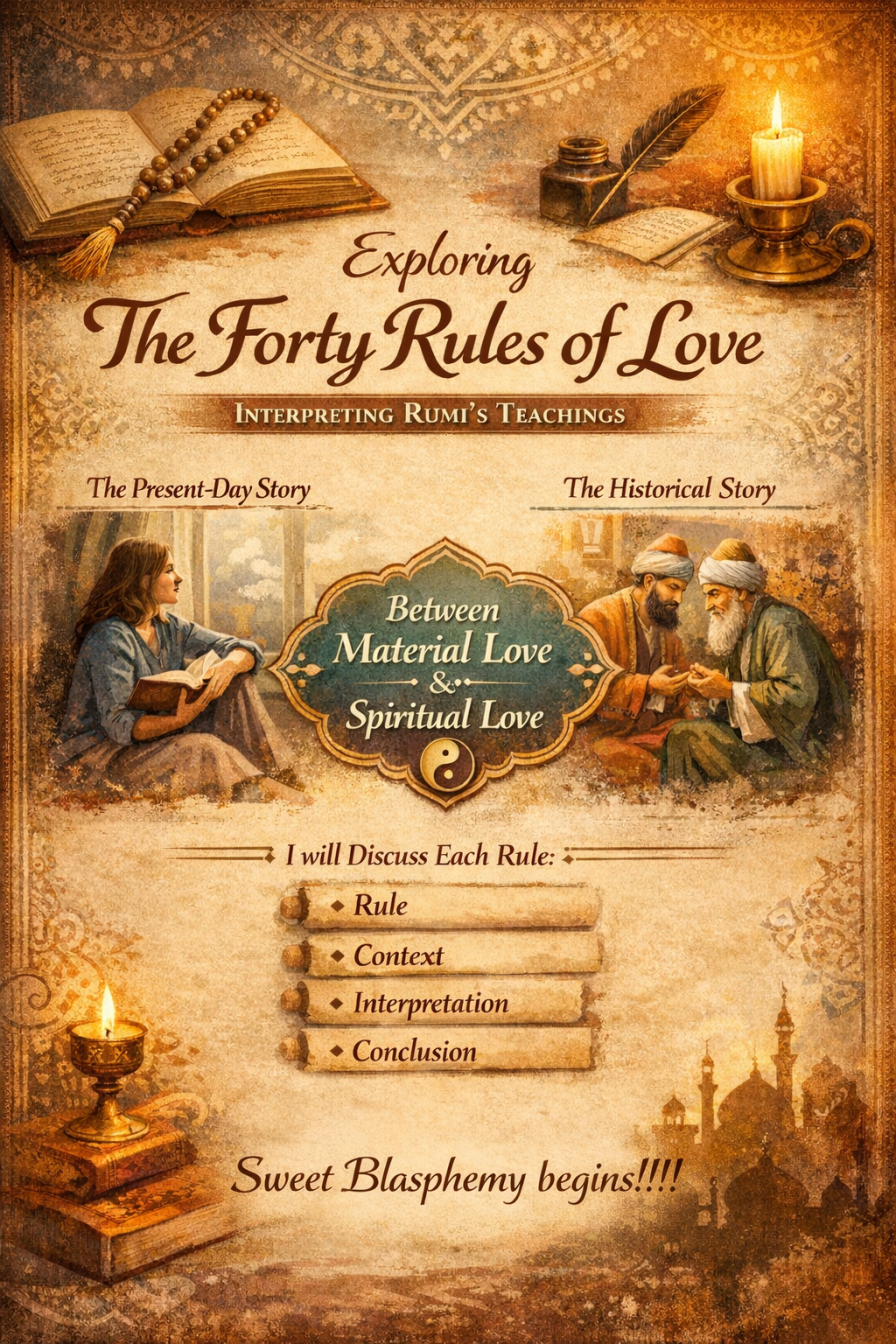
Exploring The Forty Rules of Love - The Sweet Blasphemy
A couple of years ago, I happened to write a series of articles sharing my interpretations of Maulana Jalāl al-Dīn Muḥammad Rūmī’s poems. It was a wonderful experience, as it allowed me to understand Rumi’s wisdom by deeply diving into his poetry.
At the same time, it was not the first time I had come across Rumi’s wisdom. About 5–6 years earlier, a friend gifted me a book titled The Forty Rules of Love - https://www.youtube.com/watch?v=1RE7HCkGDj0 , through which I received my initial glimpses of Rumi’s teachings. For those who are not familiar with The Forty Rules of Love, here is a brief synopsis of the book:
The Forty Rules of Love by Elif Shafak is a novel that weaves together two parallel love stories — one set in the present and the other in the 13th century — both centered on spiritual transformation through love.
The Present-Day Story
Ella Rubinstein is a 40-year-old housewife in the U.S. who feels emotionally numb and stuck in a routine life and a distant marriage. She begins working as a reader for a literary agency and is assigned a manuscript about the Sufi poet Rumi and his spiritual companion, Shams of Tabriz.
As Ella reads, she becomes deeply affected — not just intellectually, but personally. She starts corresponding with the author of the manuscript, Aziz Zahara, and their exchange gradually awakens her heart, courage, and longing for a more authentic life. The story pushes her to question safety, conformity, and what real love demands.
The Historical Story
The manuscript Ella reads tells the story of Rumi, a respected religious scholar whose life changes completely when he meets the wandering mystic Shams of Tabriz.
Shams lives by “forty rules” of spiritual love — principles about surrender, the ego, God, and the transformative power of love. Through his unconventional and often shocking teachings, Shams breaks Rumi’s attachment to status, intellect, and social approval, guiding him toward divine love and inner awakening. Their deep spiritual bond provokes jealousy, misunderstanding, and conflict within Rumi’s community.
As I understand the book, The Forty Rules of Love represents the intersection between materialistic love and spiritual love.
As a novice in the spiritual realm, I was initially intrigued by the title of the book and wondered whether love could have rules. However, as I went through the two parallel stories of Ella & Aziz and Rumi & Shams, I realized that the book goes beyond names, rules, boundaries, or stereotypes.
As we move through this month of love, a thought has arisen within me to write interpretations of all The Forty Rules of Love. Naturally, these interpretations will reflect my personal understanding of the book and its rules. It is not necessary that everyone will agree with them, nor is there any need for such agreement. Others are free to have their own understandings and interpretations.
I felt inspired to interpret these rules because I believe there are many dimensions through which they can be understood and explored.
Therefore, I would like to cover these rules based on the following points:
Rule
Context
Interpretation as per the context of the story
Other interpretations
Conclusion
Since there are a total of 40 rules, I plan to cover one rule per week in each article. This way, we should be able to cover all 40 rules by the end of this year, or at the latest by February 2027.
Let’s see how The Sweet Blasphemy unfolds!
Gratitude!!!


Leave a Reply