
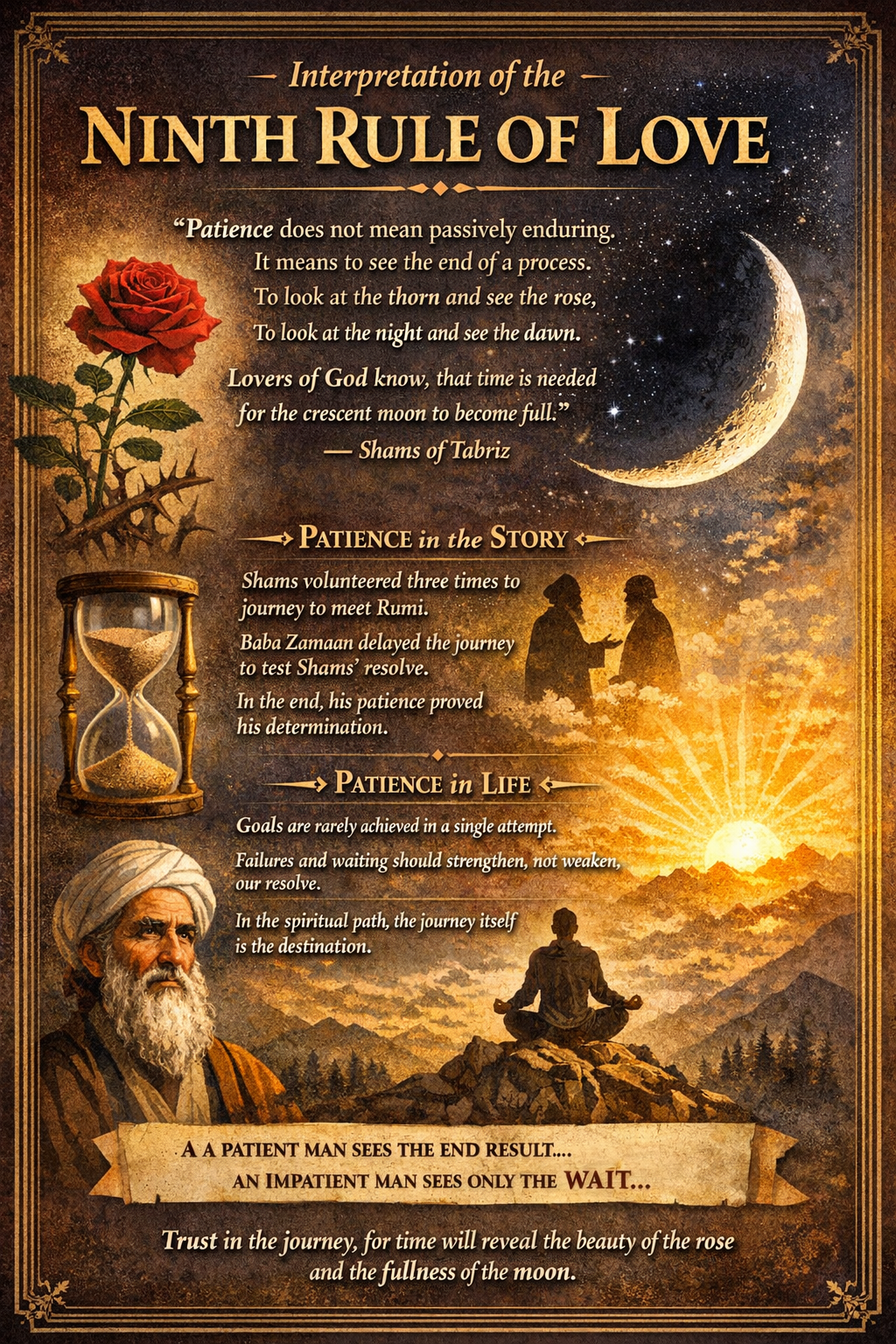
Interpretation of the Ninth Rule of Love
Rule Number 9 — Patience does not mean to passively endure. It means to look at the end of a process. What does patience mean? It means to look at the thorn and see the rose, to look at the night and see the dawn. Impatience means to be shortsighted as to not be able to see the outcome. The lovers of God never run out of patience, for they know that time is needed for the crescent moon to become full.
– Shams (to Self)
Context
This rule appears during the same period when Shams was patiently waiting for permission from Baba Zamaan to undertake the journey from Baghdad to Konya to meet Rumi. Baba Zamaan, the Master of the Dervish Lodge, kept him waiting even though Shams volunteered himself on all three occasions when the Master invited someone to take on the journey.
With each postponement, Shams became even more patient and determined. It is in this context that Shams recalls this rule, illustrating the virtue of patience.
Interpretation within the story
In many ways, this rule closely resembles the previous Rule Number 8, as both arise from the same circumstances.
It once again highlights the importance of surrender to the Guru, trusting that the Guru knows what is best for the disciple. Although Shams volunteered himself three times to undertake the journey, Baba Zamaan continued to postpone the decision. As I understand it, there were mainly two reasons behind this delay.
A. Baba Zamaan was fully aware of the dangers involved in the voyage. Whoever undertook the task of travelling to Konya to meet Rumi might never return alive. As he began to grow fond of Shams, he did not want to put Shams’s life at risk because of it.
B. He also wanted to test the determination of Shams. This is why he waited for Shams to volunteer three times. Shams’s repeated willingness convinced Baba Zamaan that the waiting period had only strengthened his resolve rather than diminishing his zeal.
Thus, as the rule suggests, patience ultimately rewarded Shams.
Deeper interpretation beyond the story
This rule can be understood in both aspects of life: material and spiritual.
Even in material life, it is rarely the case that goals are achieved in a single attempt. Often, a person must go through repeated efforts before attaining success. One may try many times, fail many times, and yet gather the courage to try again.
History provides many such examples. Both Lionel Messi and Sachin Tendulkar had to wait for decades to achieve their World Cup victories. They demonstrated immense patience before finally reaching their long-awaited goal.
What is most important is that repeated failures and long waiting periods did not diminish their enthusiasm. Instead, these experiences strengthened their determination. This principle applies to all of us who pursue any goal in life. Patience should help us prepare better for the next attempt rather than weaken our resolve.
Similarly, in spiritual life the journey can be even more demanding, challenging, and seemingly endless. In fact, it is a never-ending journey. That is why the Upanishads emphasize on “Charaiveti, Charaiveti”. It is a Sanskrit phrase that means “Keep moving, keep going” or “Move forward continuously.” It means that a spiritual seeker should simply keep walking without constantly thinking about the destination. In this path, the journey itself is the destination. There is no separate goal to be attained.
Therefore, the spiritual path requires patience and persistent effort despite repeated failures or rejections. Such setbacks only test the determination of the seeker. Waiting patiently should make the seeker stronger and better prepared for the challenges ahead. One must recognize that this period of waiting is also an essential part of the journey.
In this rule, Shams explains the difference between a patient person and an impatient one. A patient person is able to foresee the fruit of patience and therefore has no difficulty waiting for it. An impatient person, however, complains constantly about the delay because they cannot see the eventual result. Their vision remains limited.
A spiritual seeker understands that this journey takes time, for it begins after countless lifetimes. Therefore, expecting immediate results is unrealistic.
Another significant element of this part of the story is that Baba Zamaan waited for Shams to volunteer three times. This gesture convinced Baba Zamaan that the waiting had only intensified Shams’s determination. In many spiritual traditions, it is common for a Guru to repeat an instruction to the disciple three times and also seek confirmation from the disciple three times.
The purpose is to ensure complete clarity and certainty that the disciple fully understands what is being asked and what they themselves are seeking.
Gratitude!!!


Leave a Reply